
Research Collaboration Workshop in Contact and Symplectic Geometry/Topology
Overview
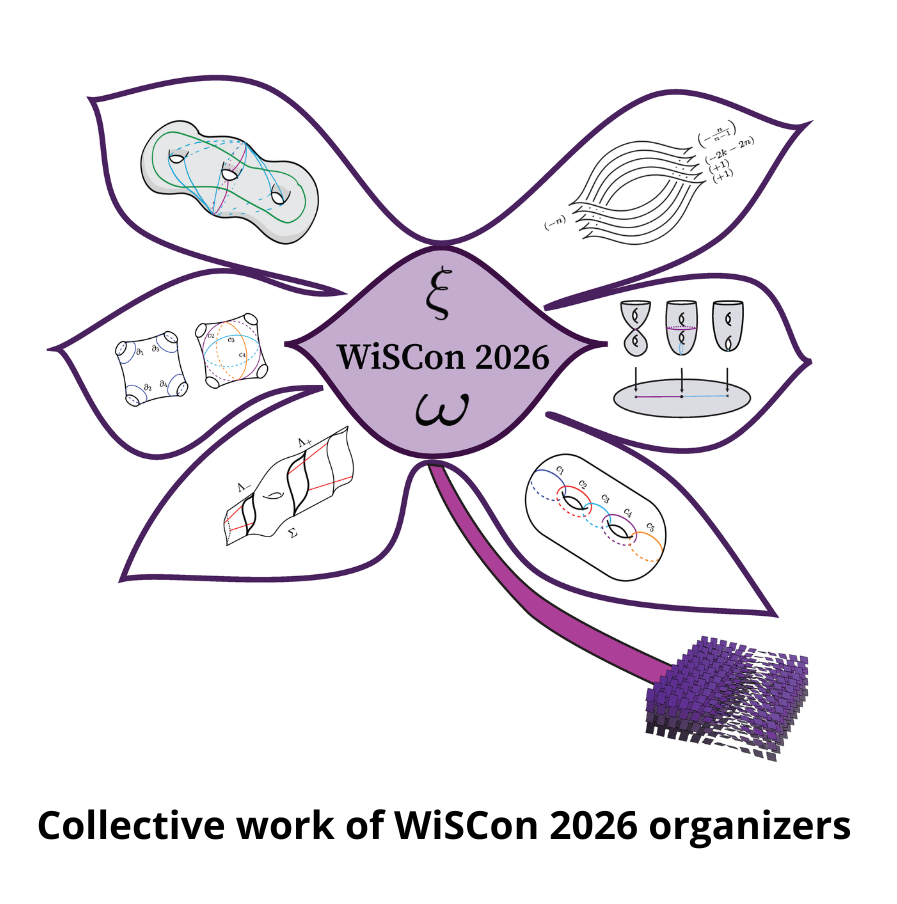 The second WiSCon workshop is a research collaboration conference in the fields of symplectic and contact geometry/topology and related areas of low-dimensional topology. The goal of this workshop is to bring together researchers at various career stages in these mathematical areas to collaborate in small groups on projects designed and led by leaders in the field.
The mathematical fields of symplectic and contact geometry/topology, rooted in concepts from classical physics, have experienced substantial growth over the past several decades. This growth has taken many forms, including the development of multiple homology theories, advances in symplectic embedding problems, techniques for regularizing moduli spaces of pseudoholomorphic curves, and emerging connections to mirror symmetry, among others. This workshop aims to generate research collaborations that build on the momentum in these areas, while strengthening professional networks and contributing to the broader effort of broadening participation in geometric topology. In particular, the program emphasizes support for early-career researchers and scholars from groups historically underrepresented in symplectic and contact geometry and topology.
This week-long workshop builds on the successful inaugural WiSCon workshop by engaging researchers in in-depth discussions and hands-on problem-solving. Its format is modeled after the successful sequence of Association for Women in Mathematics (AWM) research network collaborations. Our primary aim is to cultivate new, long-lasting collaborations among researchers in this specialized field. Participants will range from advanced graduate students and postdoctoral scholars to senior faculty members and professional researchers.
We intend to leverage this one-week program as a focused platform for participants to convene in person, explore problems of mutual interest, exchange expertise, and build professional networks, thereby laying the foundation for sustained collaboration and research innovation. Successful applicants will be assigned to a research project based on their background and interests. Participants will form groups of four to six members, each led by two project leaders, and will work intensively on open problems drawn from the project descriptions. The collaborative structure is designed to promote mentorship, sustained interaction, and the development of long-term research partnerships.
Organizing Committee
Loading organizing committee…