
Algebraic Geometry: A Window to Machine Learning
Overview
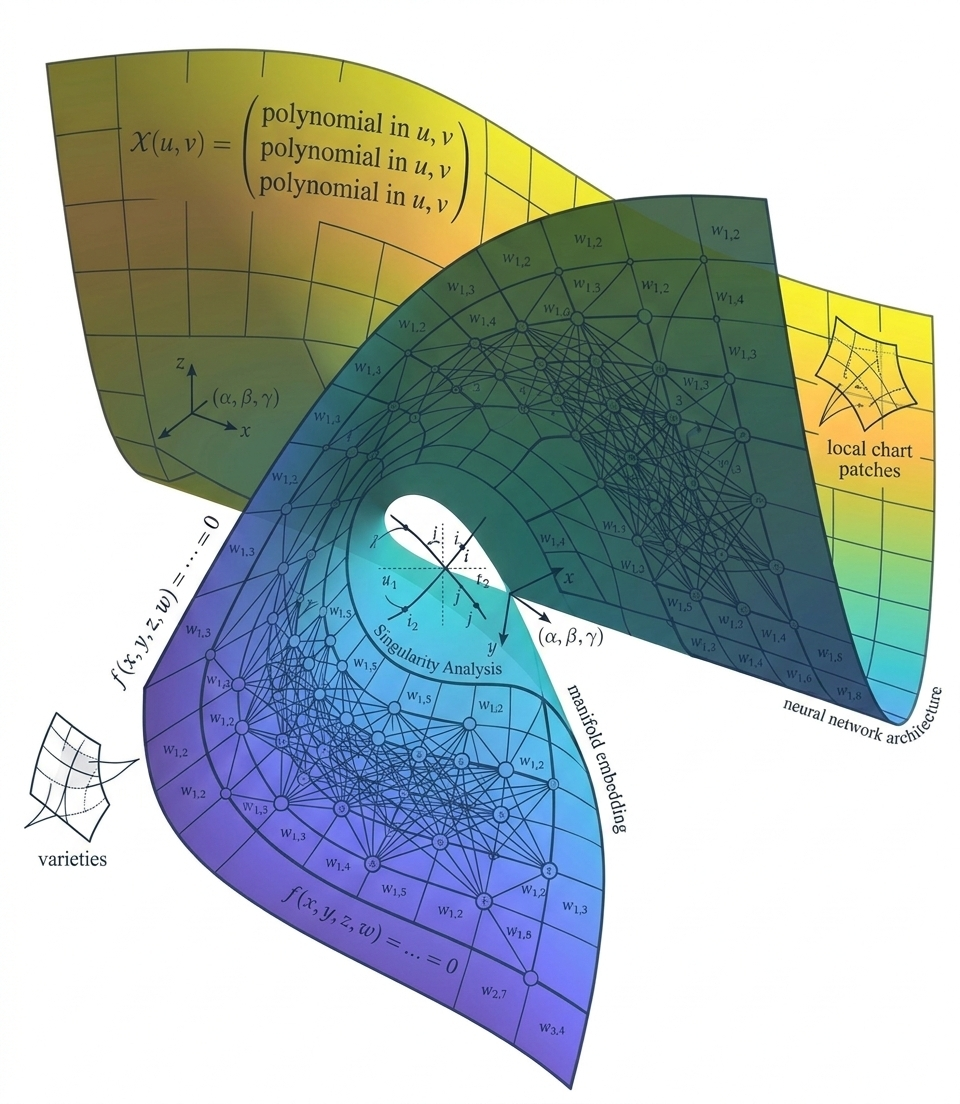
This workshop brings together researchers in algebraic geometry and machine learning to develop new mathematical frameworks for understanding learning systems. Recent work has begun to reveal rich algebraic and geometric structure in neural networks, including algebraic invariants of model classes, symmetries and fiber structures in parameter spaces, and geometric subdivisions of data space such as Voronoi regions of estimators. These perspectives offer new ways to analyze neural networks beyond linearized regimes, providing insight into optimization dynamics, implicit bias, generalization, and robustness. The workshop will focus on fundamental phenomena in modern deep learning for which adequate theoretical tools are still lacking. These include feature learning, delayed generalization (grokking), neural collapse, low-rank adaptation, neural network verification, neural compression, the benefits and failures of mild overparameterization, and length generalization in sequence-to-sequence models under finite training horizons. Many of these topics suggest underlying algebraic or geometric structure that remains poorly understood. Algebraic geometry offers a principled framework for identifying and exploiting such structure, enabling rigorous analysis of phenomena that remain opaque to existing theoretical tools.
Algebraic geometry provides a natural language for studying the geometry of data, parameter spaces, function classes, and optimization trajectories. Recent advances in computational algebra, polynomial invariants, tensor geometry, and semi-algebraic methods offer promising tools for analyzing questions arising in contemporary machine learning. By connecting developments in pure and computational algebraic geometry with frontier problems in learning theory and applications such as certification, trustworthy AI, compression, and privacy, the workshop aims to catalyze a rapidly growing research community and foster new cross-disciplinary collaborations.
This workshop will include a poster session; a request for posters will be sent to registered participants in advance of the workshop
Featured image visualized in MATLAB and enhanced with Gemini and Claude. MML group and Aryan Dalal.
Organizing Committee
Loading organizing committee…